Are we helping people, or just counting them?
The Regulars
It’s a Monday morning in a community centre. The kettle is on, the biscuits are out, and there’s a sign-in sheet on the table by the door. The course is called something like Digital Skills for the Workplace. Around the room are a dozen adults, and I know at least half of them. Not from here, but from the key skills course at the library last month, the employability workshop at the charity down the road, and the CV session before that.
They are, for want of a better word, the Regulars.
Every signature on that sheet matters. Not to the people signing it, but to the spreadsheet it ends up in. Attendance is the currency of adult community learning. Enough bums on enough seats, and this quarter’s targets are met, the funding is secured, and the cycle starts again next term with a new course title and the same faces.
But numbers aren’t the only thing extracted. Funders want good news, and good news needs a face. So there’s the photo of someone smiling with a certificate. There’s the case-study quote about growing in confidence, and the short paragraph in the annual report about how the programme turned a life around. I have known the same man appear as a success story for umpteen different organisations in the same year. One life, several turnarounds, and not much changed.
One life, several success stories, and nothing much changed.
Let me be clear: nobody in this story is doing anything wrong. The staff and volunteers running these sessions mostly care deeply, and many are as frustrated as I am. Providers, charities and council teams are all using the system exactly as it has been built. That’s the point. The problem isn’t the people in the room, on either side of the table. It’s the design.”
So why do the Regulars keep coming? Some come for the company and the warmth, and that matters more than any funder’s form recognises. But for many, the honest answer is simpler: a course on the calendar keeps the work coach satisfied, and a couple of weeks without the threat of a sanction is a couple of weeks of peace.
Here’s the uncomfortable conclusion. The Regulars aren’t failing. And in a sense, neither are the courses. They are succeeding brilliantly at what they’re actually funded to do, which is to generate attendance, produce good-news stories, and keep people compliant. What they were never designed to do is make anyone’s life better.
Wanting to be the teacher
Talk to the Regulars for any length of time and you’ll find that almost all of them want to be something. They aren’t short of aspiration. If anything, they have it in abundance.
One man I’ve worked with told me he wants to be a guitar teacher. He can’t play the guitar. A couple of years ago, he wanted to be a golf coach. He doesn’t play golf.
It would be easy to smile at that, and plenty of people do. But I think it’s worth taking seriously, because the pattern repeats right across the group. Someone sees a performance, a programme or a person who lights them up, and they want to do what that person does. The trouble is that the aspiration lands several rungs up a ladder whose bottom rungs are missing.
Aspiration isn’t the problem. The ladder is missing its bottom rungs.
Look again at what he wants to be, though. Not a guitarist: a guitar teacher. Not a golfer: a golf coach. I don’t think that’s an accident. After years of courses, the people in his life with visible status, respect and purpose are the ones standing at the front of the room. Tutors, coaches and facilitators are the most successful adults many of the Regulars ever meet. Of course that’s what he wants to become. Without anyone intending it, we have modelled one kind of success and kept him on the wrong side of the table.
He came to a guitar and music workshop I facilitated as a volunteer for around eight weeks. He also attends sessions in Heywood run by friends of mine, one of which is a Build a Business course. Not long ago, its facilitator collared me: “I’m going to kill you. He wants to set up a business as a guitar teacher!”
We laughed. Then we had the conversation that sits at the heart of this post: what can we actually do to genuinely help him? My suggestion was honest rather than crushing. Practise more, learn some music theory, and then we can look together at realistic pathways, perhaps one day towards offering private lessons. The dream doesn’t need killing. It needs foundations.
And foundations are the real issue. Maslow’s famous hierarchy puts self-actualisation and esteem at the top, resting on safety and belonging underneath. My reading of most of the Regulars is that they are reaching, sometimes desperately, for the top of that pyramid: to become someone and to be respected by the group. Meanwhile the levels beneath are shaky. Precarious income, the constant threat of sanctions, and complicated lives and histories all sit there. Gabor Maté’s In the Realm of Hungry Ghosts is a compassionate guide to why so many people end up here. His central insight is that the coping behaviours we judge so readily are usually responses to pain, and that the useful question is what happened to someone, not what’s wrong with them.
Paulo Freire would say that education should begin exactly here: with what people already care about, rather than with what a funder has decided they need. Starting is the easy bit, though. Keeping going is something else entirely.

Why motivation isn't enough
When I start someone on a new journey, whether it’s guitar, coding or soldering, I often sketch a little graph. One line is skill. The other is motivation.
At the beginning, motivation is sky-high. Everything is new and exciting, and the dream feels close. Skill, meanwhile, is close to zero. Then, as you practise, the lines start to move in opposite directions. Skill creeps up slowly. Motivation drains away, because the novelty wears off, your fingers hurt, and you realise just how far away the dream really is.
The point where those two lines cross is where most people stop.
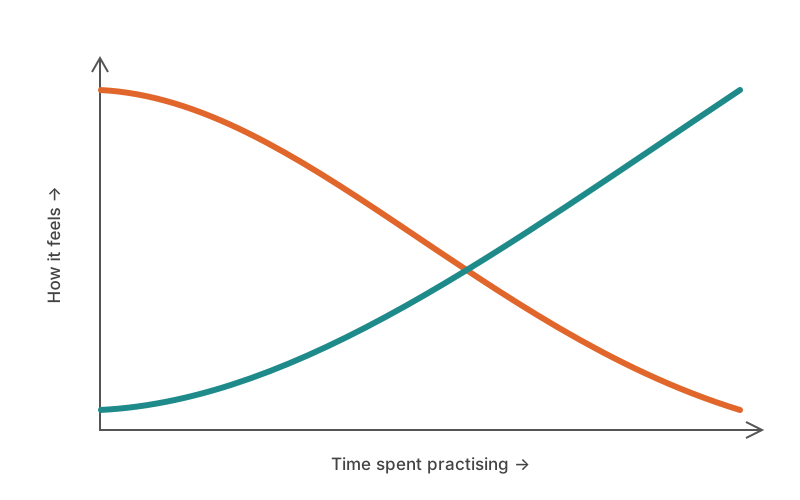
What gets you past that point isn’t more motivation. It’s turning up anyway.
What gets you past that point isn’t more motivation. It’s turning up anyway: on the days you can’t be bothered, when it feels pointless, when you’re no good yet. That’s where proficiency is built. Satisfaction comes later, as a by-product of being good at something, not as fuel for getting there.
Now look at how adult community learning is structured. Most courses run for a few weeks. They start with enthusiasm and finish with a certificate, roughly at the point where the work gets hard. Then a new course starts, with a new title and a fresh burst of motivation. Golf coaching, then guitar teaching. The system keeps people endlessly on the left-hand side of the graph, where hope is high and skill never accumulates.
Children don’t get through that crossing point on willpower either. They get through it because school is simply where you go on a Tuesday. Your friends are there, the adults know your name, and nobody makes a fuss when you have an off day. Regularity and belonging carry them through the dip that motivation can’t.
That, I think, is the clue.
Back to the beginning, not back to childhood
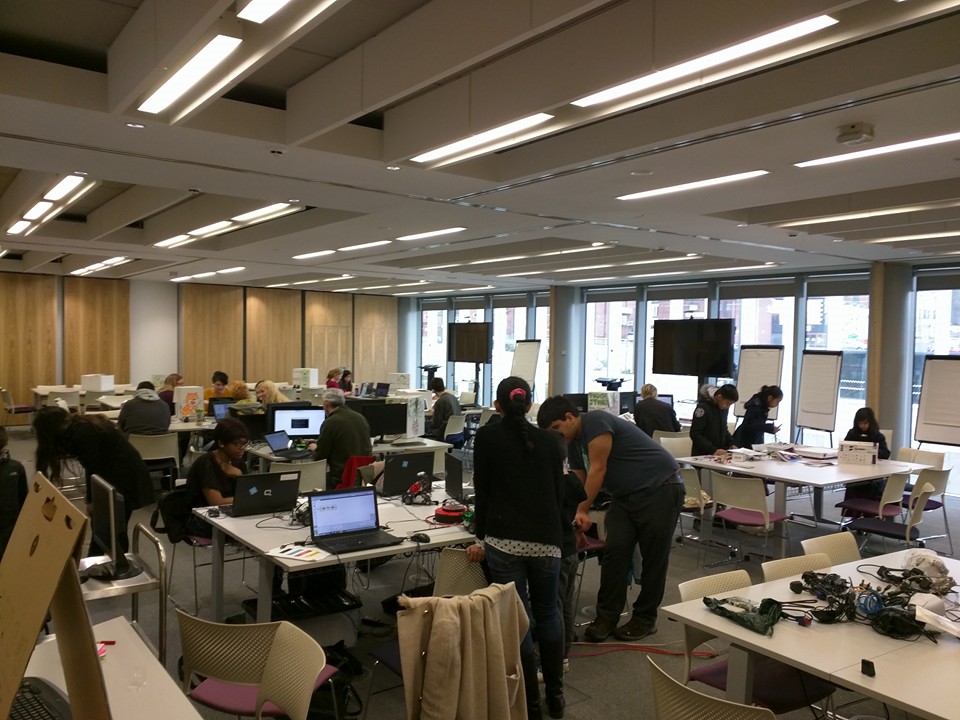
My instinct, after years of watching this, is that the Regulars need to start their education again from the very beginning. Not another rung on the employability ladder, but a fresh start, like the one we all had when we first walked into infant school.
I need to be careful here, because there’s a version of that idea which is insulting. Paulo Freire, the Brazilian educator whose work underpins this whole post, was scathing about adult literacy programmes that taught grown men and women from children’s primers. Workers who built houses and cut sugar cane were handed sentences about little girls and grapes. Freire saw this as more than useless. It told adults that their own lives and knowledge counted for nothing. He called the alternative a “banking” model of education, where knowledge is deposited into people as if they were empty accounts.
His approach worked the other way round. His teams spent time in a community first, listening for the words that carried weight in people’s lives: brick, work, wage, land. These were generative themes, and they became the material for learning to read, write and argue. People learned literacy by reading their own world, and in doing so began to question it.
So when I say “start again like infant school”, I don’t mean treat adults like children. I mean borrow something specific from the best early-years education, and combine it with Freire.
The freedom of the infant classroom. The subject matter of adult life.
From the infant classroom: how we learn
- A regular place to go, at the same time, with the same people
- Play, curiosity and exploration before outcomes
- Painting, making, games, music and stories read aloud
- No failing, no tests, no certificates to chase
- Adults who know your name and notice when you’re missing
- Learning that follows interest rather than a syllabus
From Freire: what we learn about
- Starting from people’s own words and worlds
- The Jobcentre letter, the sanction, the bus timetable, the guitar
- Dialogue, not delivery: facilitators who learn too
- Reading and writing as tools to understand and change things
- Local history as material, from the mills to the Pioneers
- Participants gradually shaping and running it themselves
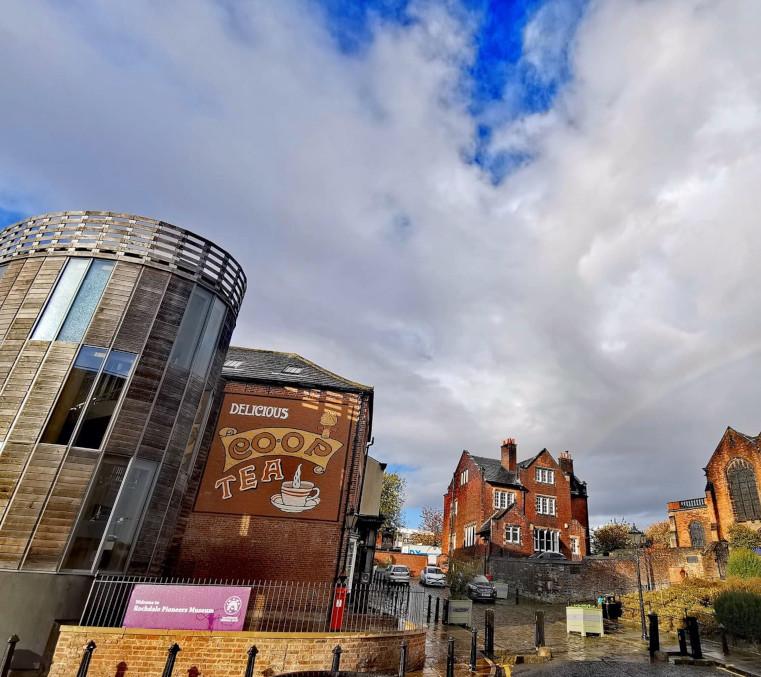
This isn’t as radical as it sounds, and Rochdale of all places should know that. In 1844, the Rochdale Pioneers opened their shop on Toad Lane. Education wasn’t a bolt-on for them. They set aside part of their profits for it and ran their own library and newsroom, because they understood that people who can read their world can change it. The co-operative movement that spread around the globe from this town was, at its heart, a self-education movement.
What I’m proposing is the same idea, for the people our current system has quietly written off. The question is what it would take to do it properly.
What we fund now, and what we could fund
Here’s the thing that frustrates me most. We are already spending public money on the Regulars, often a lot of it, spread across councils, charities and providers, course after course, year after year. The question isn’t whether to spend. It’s whether we keep paying for attendance or start paying for change.
We’re already spending the money. We’re just buying the wrong thing.
What we fund now
- Short courses with a start date and an end date
- Attendance, counted and reported
- Certificates as proof of progress
- Good-news case studies for the annual report
- Targeted at “the unemployed”, with all the stigma that brings
- Attendance as a condition of benefits
- Tutors delivering a set syllabus
- Project grants that come and go with each funding round
What we could fund
- A place that’s open all year, every year
- Belonging, counted by people choosing to come back
- Happiness and wellbeing as the headline measure
- Participants’ own stories, told in their own words
- Open to anyone in the community, sited where need is greatest
- Attendance that’s freely chosen, outside the sanctions regime
- Facilitators who listen, and a curriculum that grows from the group
- Steady, recurring funding, like a school or a library
Two things on that list matter more than the rest.
Freedom. Freire’s whole approach rests on dialogue, and dialogue can’t happen under threat. If people attend because missing a session might cost them their benefits, it isn’t education. It’s compliance with better biscuits. A properly funded model would need to sit outside the conditionality regime, or at the very least be recognised as valuable in its own right without becoming another box to tick.
Measurement. Funders and councils reasonably need to know whether money is doing good. I’m not arguing against measurement. I’m arguing for measuring the right thing. The Office for National Statistics already asks four simple personal wellbeing questions about life satisfaction, feeling that what you do is worthwhile, happiness and anxiety. They’re validated, they’re used across government, and they ask about the thing that actually matters. Put them alongside people choosing to come back week after week, and participants’ own accounts of what has changed, and you have an evaluation that tells the truth.
Imagine this funded nationally, the way Sure Start once was for young families: a network of community learning places in our most deprived towns, open to anyone, judged by whether people are happier. That’s the vision. But visions are cheap, and none of this is untested.
It's been done before
None of what I’m proposing is new. People have been building this kind of education for nearly two centuries, often in places much poorer than Rochdale, and often with remarkable results.
Danish folk high schools. In 1844, the same year the Pioneers opened on Toad Lane, the first folk high school opened at Rødding in Denmark. Inspired by the pastor and philosopher N.F.S. Grundtvig, these were schools for ordinary rural people, with no exams, no qualifications and no entry requirements. Grundtvig called them a “school for life”. People lived and learned together, through conversation, singing, history and practical work. They’re still going today, and they’re widely credited with helping to build the culture of co-operation and trust that Denmark is known for.
Highlander Folk School, Tennessee. In 1932, Myles Horton, who had visited the Danish schools, co-founded Highlander in the Appalachian mountains. It brought together miners, mill workers and farmers to learn from each other’s experience and work out how to change their circumstances. In the 1950s it trained the teachers of the Citizenship Schools, which taught Black adults in the segregated South to read and write so they could register to vote. Rosa Parks attended a workshop there a few months before refusing to give up her bus seat in Montgomery. Late in life, Horton and Paulo Freire wrote a book together, We Make the Road by Walking. Its title is a decent summary of everything in this post.
REFLECT. In the 1990s, the charity ActionAid combined Freire’s ideas with participatory community mapping to create the REFLECT approach. Instead of primers, groups drew maps, calendars and charts of their own villages, then used them to learn literacy and tackle local problems. It was piloted in Uganda, Bangladesh and El Salvador, and has since been used by community groups in dozens of countries.
Our own tradition. Britain has a proud history of this too. Nineteenth-century working people talked about “really useful knowledge”, meaning the education they organised for themselves, as opposed to what their employers thought they should know. Mechanics’ institutes, the Workers’ Educational Association, founded in 1903, and the Plebs League all grew from that spirit. More recently, the Citizens’ Curriculum approach, developed by the Learning and Work Institute, has piloted participant-led adult learning in England. People shape what they learn, and literacy, numeracy and digital skills are woven together with health, money and civic life.
Just over the hill. The closest example is in the next town along. In Todmorden, already famous for Incredible Edible’s food-growing movement, local people spent around five years campaigning and fundraising to stop their former community college being bulldozed for a supermarket car park. In spring 2021, Calderdale Council transferred the building into community ownership. It now runs as Tod College, a community benefit society, alongside a busy community hub with workshops, rehearsal rooms, children’s clubs and sport. Its Climate Challenge College teaches natural building, agro-ecology and renewable energy. It isn’t aimed at the people I’m writing about here, but it proves that the hardest part can be done a few miles from Rochdale: a community winning, owning and running its own place of learning.
None of this is new. What’s new is how badly we need it.
The pattern across all of these is the same. They begin with people’s own lives. They’re rooted in a place. They value belonging as much as content. And they trust ordinary people to work out what they need to know. The question is what a modern version could look like here, starting small.
A lifelong learning centre for Rochdale
Rochdale is not short of space. Walk through the town centre and you’ll pass empty department stores, a mothballed shopping centre, closed banks and boarded-up pubs. Buildings that once brought people together now sit waiting for a developer who may never come.
We’ve tried borrowing one before. In 2021, the former Marks & Spencer on Yorkshire Street reopened as the Better Together hub, with free space for around fifteen charities, a pay-what-you-can café and a ribbon cut by Nazir Afzal. It did real good. But it was always a temporary arrangement, tied to the remainder of M&S’s lease. Two years later, with no heating, no running water and asbestos in the unused floors, notice was served and everyone had to leave. The building is still boarded up.
We don’t need another meanwhile use. We need a forever use.
So here’s what I’d propose. One empty public building, transferred into community ownership on a long lease, as Todmorden did with its college, and opened as a shared learning house for the whole town. Not my sessions. Not any one provider’s. Everybody’s. Charities, council teams, colleges, artists and makers would all run sessions there, under one set of rules:
- Open every weekday, all year round, with the kettle on
- Free and open to anyone, with nobody sent there under threat of sanction
- A core programme on weekday mornings, run by a small team of facilitators, with no syllabus in the first term: just making, painting, music, games, reading aloud and conversation
- Partner organisations using the space in the afternoons and evenings, on the same terms
- Food at the heart of it: cooking and eating together
- Wellbeing measured from day one, using the ONS questions, return visits and people’s own stories
- Governed as a co-operative, with participants on the board from the start
The first year
- Months 1–3: Listen. Open the doors, make tea, and listen for the themes that matter to people.
- Months 4–9: Play and make. Build the core programme around those themes. Invite partners in.
- Months 10–12: Hand over. The group itself shapes year two.
What it might cost
These are my own rough estimates for running costs, assuming the building comes through asset transfer at a nominal rent:
| Item | Per year |
|---|---|
| Two full-time facilitators, including employer costs | £75,000–£85,000 |
| Part-time coordinator and administration | £18,000–£22,000 |
| Building running costs: energy, insurance, cleaning, minor repairs | £30,000–£50,000 |
| Food and materials | £12,000–£18,000 |
| Sessional artists, musicians and makers | £8,000–£12,000 |
| Independent evaluation | £8,000–£10,000 |
| Total | roughly £150,000–£200,000 |
Getting the building fit for use would be a separate, one-off capital cost, and that depends entirely on which building. Todmorden shows that capital can be raised through lottery grants, regeneration funds and community share offers.
The harder lesson, which I’ve seen close good projects before, is that one-off project grants aren’t enough. Something like this needs a steady backbone of recurring funding, such as Greater Manchester’s devolved adult learning budget, with grants on top for extras. Two years of guaranteed core funding would give a fair test. If a hundred regular participants came through in a year, that’s somewhere between £1,500 and £2,000 per person, for a place that’s there every day rather than a course that ends after six weeks.
We’re already spending money on these people. The question is whether we spend it on a building full of bums on seats, or a place where people can finally start again.